The garage quote lands and the number stops you cold. Before you authorise anything, one question matters more than everything else. Is this car actually worth repairing? The answer depends on a clear financial threshold, your car’s real current market value, and an honest assessment of what else is likely to fail. This guide gives you the calculation, the fault types that almost always cross the line, and what your options are once the math turns against you.
What Is the Repair Cost Threshold?
Two thresholds are used in the UK motor trade and by insurers to decide whether a car is worth repairing. The 50% rule is the stricter standard. If a single repair costs more than 50 percent of the car’s current market value, most financial advisors and motor trade professionals consider replacement the smarter decision. This is the benchmark used by many UK insurers when calculating total loss declarations.
The 70% rule is the broader threshold applied to older or higher mileage vehicles. Once the repair estimate reaches 70 percent of market value, the case for repair breaks down in almost every scenario. The repair restores function today but does not reset the clock on every other ageing component around it. UK insurers in practice typically declare a total loss when repair costs hit 50 to 60 percent of pre-accident market value, factoring in their own engineer labour, storage fees, and administrative overhead on top of the parts and labour estimate.
| Repair Cost vs. Market Value | Verdict |
| Under 40% | Usually worth repairing if history and mileage support it |
| 40–49% | Borderline assess age, mileage, and potential future failures |
| 50–69% | Repair rarely makes financial sense. Apply the 50% rule |
| 70% and above | Scrap or salvage repair cost exceeds vehicle value |
How to Calculate Your Car’s Real Market Value
The threshold calculation only works with an accurate market value. Most owners overestimate what their car is worth.
Use three sources: Auto Trader’s valuation tool, Parkers, and live listings for the same make, model, year, mileage, and condition in your region. The realistic private sale price sits at the lower end of that range. A full HPI check will reveal any outstanding finance, previous write off categories (Cat S, Cat N, Cat A, or Cat B), and the number of previous keepers. All of which reduce real world value below what the guides show.
The DVLA’s free vehicle enquiry service confirms MOT history and mileage readings at each test. A car with a high mileage at its last MOT and a gap in service records is worth noticeably less than the standard guide price suggests.
Adjust downward for any existing condition issues: advisories on the last MOT, worn interior, partial service history, or non standard modifications. These factors are subtracted by every buyer and every dealer, even if the guides do not reflect them automatically.
Repairs That Make a Car Uneconomical to Fix
Certain fault categories consistently produce repair quotes that breach the 50 to 70 percent threshold. Parts now account for 52 percent of the total repair bill on average in the UK, and labour rates have risen 20.8 percent over the past four years. Both factors push the following faults past the economic limit on any car worth under £7,000.
Engine Seizure or Internal Engine Damage
Full engine replacement costs between £2,500 and £5,000 for parts and labour depending on whether a remanufactured or used unit is fitted. A snapped cambelt or stretched timing chain that has allowed pistons and valves to collide produces the same result as a seized engine. Catastrophic internal damage that makes the 50% threshold on any car worth under £6,500. This is one of the most expensive avoidable repairs in UK motoring; manufacturers specify cambelt replacement intervals precisely to prevent it.
Automatic Gearbox or Transmission Failure
Automatic gearbox rebuild or replacement runs £1,800 to £4,500. Dual mass flywheel and clutch replacement on affected models adds £600 to £1,200 on top. On any car worth under £5,000, a gearbox failure alone frequently exceeds the economic threshold before any additional faults are considered.
Diesel Particulate Filter (DPF) System Failure
DPF replacement including associated sensors and injectors costs £1,200 to £2,200 on most diesel vehicles. High mileage diesel cars that have spent their working lives in urban stop start driving are the most common victims. At £2,200 on a car worth £3,000, the repair represents 73 percent of market value before labour variations are accounted for.
Turbocharger Failure
Turbocharger replacement costs £1,000 to £2,500 depending on the unit and the vehicle. On performance or prestige models, genuine OEM turbo units push the upper end of that range significantly higher. Labour time on turbocharged engines with restricted access adds further cost beyond the parts price.
Structural Corrosion
Rust that has penetrated chassis rails, sill sections, or subframe mounting points costs £1,500 to £3,500 to repair structurally. The MOT standard for chassis and sill integrity means the tester can fail the vehicle even after welding work if the quality of repair does not meet the required standard. Older vehicles in high salt coastal areas and those without underseal are most at risk.
ADAS and Sensor System Damage
Advanced driver assistance systems have fundamentally changed the economics of impact damage. A small bump that once meant a £300 bumper fix now triggers a much bigger bill. ADAS recalibration, parking sensor replacement, radar module realignment, and sometimes a full windscreen swap with camera recalibration all stack up. What looks like light cosmetic damage on a modern car can cost £1,500 to £3,500 before any structural work even starts.
Common Repair Types and typical UK costs in 2026
| Fault | Typical UK Cost (2026) | Crosses 50% on cars worth… |
| Engine replacement | £2,500 – £5,000 | Under £10,000 |
| Auto gearbox rebuild | £1,800 – £4,500 | Under £9,000 |
| DPF system failure | £1,200 – £2,200 | Under £4,400 |
| Turbocharger replacement | £1,000 – £2,500 | Under £5,000 |
| Structural corrosion | £1,500 – £3,500 | Under £7,000 |
| ADAS damage + recalibration | £1,500 – £3,500 | Under £7,000 |
| Cambelt failure + engine damage | £2,000 – £4,500 | Under £9,000 |
Hidden Costs Most Drivers Ignore
Repair Does Not Restore Market Value
A car worth £3,500 before a major repair does not become worth £3,500 again once the work is done. Any HPI check or history search reveals the repair. Buyers discount cars with replacement engines or gearboxes regardless of the quality of the work. The repair restores function, not resale value.
The Next Fault Is Already Queuing
Vehicles age across all systems simultaneously. A car old enough to need a gearbox is ageing through its brakes, cooling system, suspension bushes, and electrical components at the same time. Paying to fix one system today does not pause the depreciation clock on any of the others. The repair quote fixes today’s problem. It does not fix the vehicle’s age.
When Repairing Still Makes Financial Sense
The 50 to 70 percent threshold is a guide, not an absolute rule. These situations can justify a repair that crosses the threshold:
Low genuine mileage with full main dealer service history on a vehicle with no other issues. A 38,000 mile car with a clean history and a single isolated fault is a different asset from a 140,000 mile car with advisories and patchy paperwork.
Repair cost is well below 40 percent of market value on a vehicle with remaining life. A £900 alternator on a £4,500 car with 70,000 miles and a full history is worth doing.
Specialist adaptations or modifications that make the vehicle impossible to replace at equivalent cost. Disability adaptations, in particular, can make repair economically rational beyond what the standard market value calculation suggests.
Write Off Categories: What They Mean for Your Decision
Insurers use four write off categories.
- Category A means that the vehicle must be crushed, and no part may be reused.
- Category B allows parts to be stripped before the bodyshell is destroyed; neither category may return to the road.
- Category S covers structural damage that can technically be repaired.
- Category N covers non structural damage.
- Both S and N are recorded permanently against the vehicle’s HPI history and reduce resale value by 20 to 40 percent against equivalent clean history cars.
Insurers write a car off when repair costs plus salvage value go past the pre-accident market value. In practice that threshold sits at 50 to 60 percent of repair cost. Rising ADAS recalibration costs and parts delays from supply chain problems have pushed more cars into write-off territory. Damage that would have been fixed cheaply five years ago now tips the balance the other way.
Should You Scrap, Sell for Salvage, or Repair?
Once the repair cost crosses the threshold, three routes produce different financial outcomes:
Scrap Through a Licensed ATF
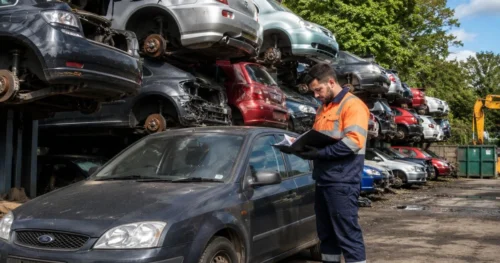
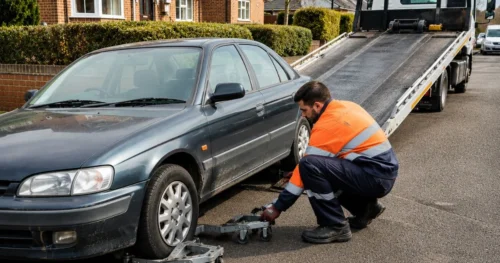
A licensed Authorised Treatment Facility collects non runners and damaged vehicles free of charge. Payment clears by bank transfer within 24 hours. A licensed ATF collects non-runners and damaged vehicles at no charge. Payment lands by bank transfer within 24 hours. The ATF issues a Certificate of Destruction and removes you from the DVLA record straight away.
Sell for Salvage
Selling for salvage returns more than scrap rates because the buyer intends to repair, resell, or strip the vehicle for parts. A car with significant mechanical damage but a sound body and intact interior can attract £400 to £1,500 from a salvage buyer, depending on make and parts demand.
Get a Second Repair Quote
Independent specialist garages charge 30 to 50 percent less in labour than main dealer rates. A £2,800 dealer estimate frequently comes in at £1,900 at an independent using a quality remanufactured part. That changes the threshold calculation enough to make the repair viable in some borderline cases.
Five Step Decision Framework
Step 1: Get an independent inspection before authorising any repair. Spend £50 to £100 on an assessment from a garage that will not carry out the work.
Step 2: Establish market value using Auto Trader, Parkers, and live listings. Run an HPI check to confirm there are no markers that reduce value below guide price.
Step 3: Divide repair cost by market value and multiply by 100. Above 50 percent on a high mileage car or above 70 percent on any vehicle means the repair does not add up.
Step 4: Get scrap and salvage quotes first. Knowing your car is worth £280 as scrap or £750 to a salvage buyer gives you a real number to work from. before arranging car scrapping in Ruislip or elsewhere in the UK.
Step 5: Factor in the replacement cost. If a reliable equivalent costs £5,500 and repair costs £2,800 on a vehicle with 140,000 miles, the total outlay comparison often favours replacement.
Frequently Asked Questions
At what point is a car not worth repairing?
A car stops being worth repairing when the repair cost passes 50 percent of its current market value on a high mileage vehicle, or 70 percent on any car regardless of mileage.
Does a major repair increase my car’s value?
Not proportionally. Any HPI or history check reveals major work. Buyers discount vehicles with replacement engines or gearboxes because those repairs signal age and condition. The repair restores function, not market value.
Can I sell a non runner or damaged car?
Yes. Non runners and fault damaged vehicles sell through scrap and salvage channels every day in the UK. Neither route requires the car to be in running condition. Scrap buyers pay by weight. Salvage buyers pay more based on parts value and repair potential.
How quickly can I scrap a car that is not worth repairing?
Most licensed UK buyers collect within 24 to 48 hours of the first quote. If you need car scrapping in Newbury, Same day collection is available in many areas. Payment clears on the day of collection by bank transfer. The Certificate of Destruction arrives within seven days.
What write off category is my car if I scrap it voluntarily?
Voluntary scrapping through a licensed ATF does not assign an insurance write off category. The ATF issues a Certificate of Destruction and notifies DVLA. The vehicle is removed from the register without any Cat A, B, S, or N marker being applied.
Get a Quote in 60 Seconds
If the repair cost on your car has crossed the threshold, scrapping or selling for salvage is almost certainly the smarter financial move. Get your free instant quote from Scrap My Car Services, free collection, same day bank transfer payment, and a Certificate of Destruction issued within seven days.