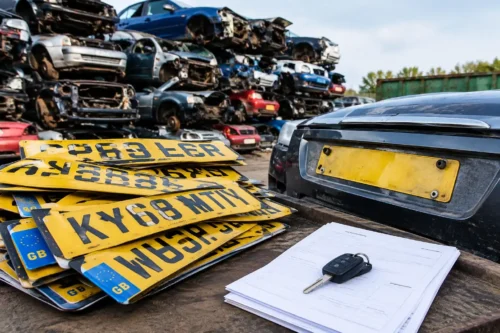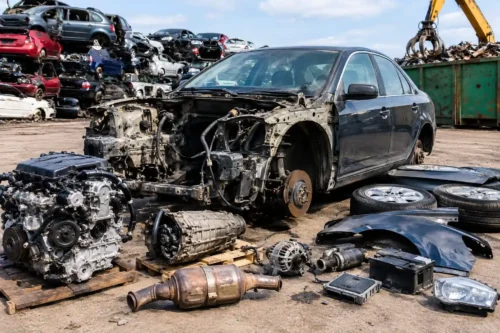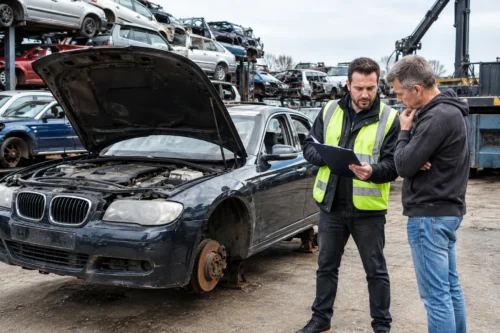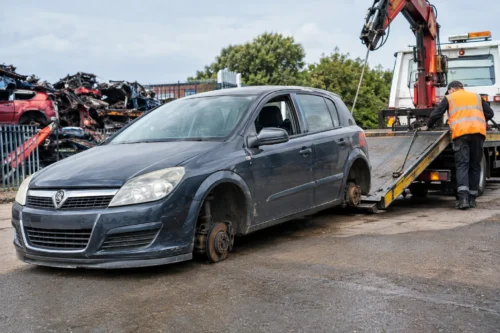
No, you cannot buy a number plate from a scrapped car in the UK. Once a vehicle is destroyed, its registration retires permanently with it and cannot be sold, transferred, or reused by anyone else, regardless of where it turns up. There is one exception worth knowing: if you’re the registered keeper scrapping your own vehicle, a personalised or private number plate can be saved and moved to another car, but only through the correct DVLA process, completed before the car reaches the scrapyard. This guide covers exactly what the law allows, what it doesn’t, and how to keep your own plate safely if you’re the one doing the scrapping.
Is It Legal to Buy or Use a Number Plate from a Scrapped Car
What UK Law Says About Reusing a Registration Number
No. A registration number has a permanent link to its original vehicle, and this rule sits inside UK vehicle law, not open opinion. Once a car is scrapped, the DVLA database retires that number for good. It does not move to another car, even if you found it sitting in a yard. The real legal hook is the Road Vehicles (Display of Registration Marks) Regulations: fitting a plate that isn’t officially recorded to your vehicle makes the display non-compliant, and that non-compliance is what the law actually punishes.
Fines and Penalties for Using a Scrapped Vehicle’s Plate
Get this wrong and you risk two levels of penalty. Police can issue an on the spot £100 fixed penalty notice for a straightforward display breach, while a court can push this up to a £1,000 maximum fine in more serious cases. As of 2026, no penalty points apply. Beyond the fine, mismatched plates risk MOT failure and can flag your car through ANPR systems, raising fraud and cloning concerns for the DVLA.
Why Number Plates Cannot Be Sold from a Scrapyard
How a Registration Number Is Permanently Linked to One Vehicle
Every registration starts life tied to one car through its original factory assignment, and that registration vehicle linkage never breaks on its own. The number is bound to the VIN/chassis at the point of manufacture, and this pairing sits recorded on the V5C logbook and inside the DVLA record. Once that vehicle reaches an Authorised Treatment Facility and is destroyed, the link stays closed the plate cannot simply move to a different car because someone likes it.
DVLA Fraud Prevention and Vehicle Identity Rules
This rule exists for fraud prevention, and the mechanics matter more than the slogan. A scrapped car’s dead VIN paired with a still active plate creates what amounts to a ghost vehicle, a combination that doesn’t officially exist, yet can dodge ANPR linked penalties, enable tax evasion, or bypass a safety inspection. Blocking vehicle cloning this way protects every driver’s right to a unique traceable identity, and guards against identity theft tied to stolen registrations.
Exception: Retaining Your Own Personalised Number Plate
Standard Plates vs Personalised Plates Under DVLA Rules
Not every plate dies with the car. A standard vs personalised classification decides what happens next: ordinary age identifier plates are destroyed with the vehicle, while cherished/private registrations can be pulled off and kept. Scrap the car and DVLA gives it a fresh replacement age related registration in place of what’s removed, while your saved number sits safely away from the crusher the same rule that protects dateless plates too.
Who Is Allowed to Retain a Plate Before Scrapping
Registered keeper eligibility is strict. You must be the person currently named on the V5C logbook, and the vehicle must be taxed or SORN’d at the time you apply. Here’s the detail most guides skip: if that SORN has lapsed for more than five years, DVLA won’t accept your application until the car is re-taxed and passes a fresh MOT. This also applies to any vehicle over three years old, or a historic car normally MOT exempt.
How to Retain a Number Plate Before Scrapping Your Car in the UK
Applying with the V317 Form
Everything starts with the V317 form. It offers Option A for a direct transfer, or Option B to place your plate on retention and here’s the part competitors blur: V317 is the application, not the certificate itself. Complete it in CAPITAL LETTERS with black ink, alongside your V5C and the vehicle’s VIN/chassis number.
Receiving Your V778 Retention Certificate
Approval brings your V778 retention document, sent with a replacement V5C for your donor car’s new age-related registration. As gov uk states plainly: you must have both in hand before you scrap or sell your vehicle, or you lose the right to that plate entirely.
Retention Fees and the 10 Year Certificate Window
Retention costs £80 and lasts 10 years, with free renewal inside the final 28 days. DVLA scrapped its old £25 annual fee back in 2015.
What Happens If the Car Is Already Scrapped or Written Off
Retention After a Voluntary Scrap vs a DVLA Write Off
The outcome depends on which path your car took. A voluntary scrap ends the moment the Certificate of Destruction is issued once that happens, retention is closed. A DVLA write off works differently: Category A and Category B cars go straight to scrap with no way back, but Category S and Category N vehicles are repairable, which can leave a short window to recover your plate before the paperwork finalises.
Contacting DVLA and Your Insurer If Retention Was Missed
If retention slipped past you, contact your insurer and DVLA straight away. Send proof and any supporting paperwork from the Authorised Treatment Facility that handled the car, since DVLA can sometimes correct a genuine administrative error even after the fact.
Transferring a Retained Plate to a New Vehicle
MOT and V5C Requirements for Transfer
Before your retained plate lands on a new car, two things must line up. The vehicle needs a valid MOT, and the V5C must show you as the registered keeper. There’s one useful exception classic car owners often miss: vehicles over 40 years old are normally MOT-exempt, but you’ll still need to complete a V112 declaration to confirm roadworthiness before DVLA will process the transfer.
Updating Insurance and ANPR Linked Services
Once the new registration is live, tell your insurer immediately so your cover matches the correct plate. Don’t stop there to update any ANPR linked accounts too, including parking apps and toll systems like Dart Charge or your ULEZ/congestion charge account, or you risk fines against the wrong vehicle. When you’re ready to scrap the donor car itself, Scrap My Car Services handles the DVLA side of the process for you, start to finish.
FAQs
Can I buy a number plate directly from a scrapyard?
No. A scrapyard plate purchase isn’t legal in the UK. The registration stays permanently tied to its original vehicle and retires with it once scrapped, regardless of physical condition.
What is the difference between the V317 and V778 forms?
V317 is the application you submit to transfer or retain a registration. V778 is the retention certificate DVLA issues once that application is approved and processed.
How much does it cost to retain a private number plate?
Retention costs £80, covering up to 10 years. Renewal within the final 28 days is free, following DVLA’s 2015 reform that scrapped the old annual fee.
Can I use a scrapped car’s plate for decorative purposes only?
This isn’t clearly confirmed by DVLA guidance. Treat decorative use cautiously, avoid public roads entirely, and check directly with DVLA before assuming it’s permitted.