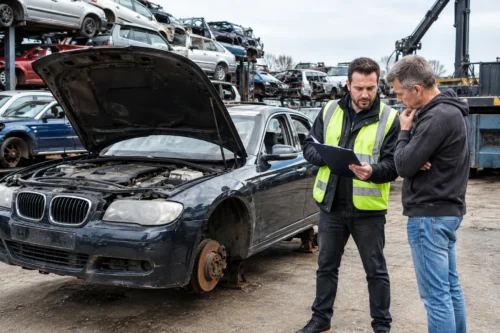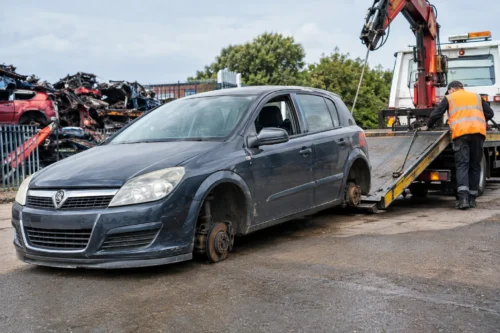
Rust does two different things to your car. It cuts your resale price, sometimes by 20 percent or more when it reaches the chassis or sills. It also decides whether your car passes its next MOT, since testers fail anything with structural corrosion inside a prescribed area. But scrap value works on a separate system entirely. Scrap My Car Services and every licensed ATF in the UK pay based on your car’s kerb weight, not its paint or panels. This guide breaks down exactly where rust hurts your resale price, where it triggers an MOT failure, and where it has almost no effect on your scrap quote.
What Rust Actually Does to a Car’s Value
Cosmetic Surface Rust vs Structural Rust
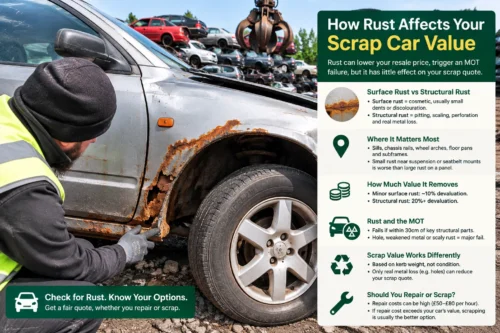
Surface rust starts as discolouration. It shows up as orange discolouration on a car’s paint. Bonnet rust and door panel rust usually stay in this stage. The metal underneath stays sound metal. Structural rust is different. It causes pitting and scaling first. Then it leads to perforation, where rust penetration eats through metal thickness. This turns flaky metal into a real risk near any load bearing component or safety critical area.
Why Rust Location Matters More Than Rust Size
Rust location matters more than rust size on any UK car. A small hole near a suspension mount or seatbelt anchorage is worse than large rust on a door. Common rust hotspots include the sill, subframe, chassis rail, wheel arch, and floor pan. These count as a structural rust point. A non structural panel rusting on the vehicle underside rarely causes trouble. A steering attachment or fuel system mount rusting always does.
How Much Value Rust Removes From a Car
Minor Surface Rust Devaluation
Minor surface rust causes the smallest hit to a car’s price. A small rust spot on a wheel arch or bonnet rust usually means a 10 percent devaluation. Door rust falls in this same range too. Most buyers call this treatable rust, since it counts as easily treated corrosion. This level brings only cosmetic devaluation. For scrap purposes, this rust has negligible scrap impact.
Structural Rust Devaluation
Structural rust brings a much bigger price drop. Chassis rust and frame corrosion often cause 20 percent or more devaluation. This level counts as severe devaluation in most UK valuations. It can lead to a safety compromise for the driver. Structural rigidity weakens, and this raises real MOT failure risk. Owners also face durability loss and reliability loss over time. Together, these add up to significant value loss.
Rust and the MOT Prescribed Area Rule
What Counts as a Prescribed Area
A prescribed area covers any point within a 30cm radius of a key structural part. This includes a body mounting point, suspension mounting, steering box, or seatbelt anchorage. A fuel system mount also falls inside this zone. The UK’s MOT Inspection Manual Appendix A sets these rules. Under DVSA guidance, testers judge rust here far more strictly. Any load bearing component or structural component in this zone gets extra scrutiny.
Why Structural Rust Usually Means MOT Failure
Inside a prescribed area, a hole through load bearing metal is an automatic fail. Structural weakening under hand pressure also fails the test. Testers reject scaly rust that flakes under scraping too. Any of these three counts as a major fail, sometimes even a dangerous defect. Testers apply strict prescribed area fail criteria here, not a simple MOT advisory. There’s a non structural repair ban too. Only continuous seam welding with a full strength steel plate passes retest.
Why Scrap Value Works Differently From Resale Value
How Scrap Valuations Are Actually Calculated
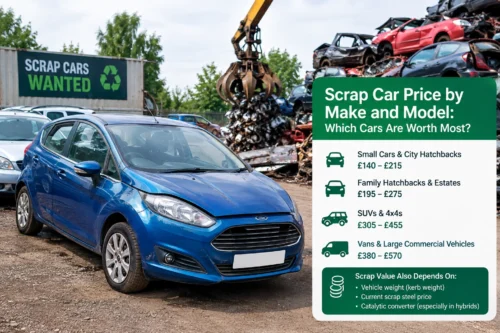
A scrap quote starts with a car’s kerb weight. This weight gets multiplied against the current scrap metal rate, the scrap metal price per tonne. This gives the base value calculation. A salvageable parts premium can raise this figure. So can catalytic converter value, based on its precious metal content. The result is a weight based quote, set through direct ATF assessment. UK law also requires 95 percent material recovery from every vehicle.
When Rust Does Reduce a Scrap Quote
Rust only lowers a scrap quote through real metal mass loss. Iron oxide flaking removes actual weight from the car. Severe perforation or a missing floor pan cause this loss. Both lead to reduced recoverable weight at collection. Rust can also create a compromised handling safety issue. A corroded chassis collapse brings unsafe lifting risk for the crew. Panel replacement absence can add to this problem too.
Should You Repair Rust or Scrap the Car
The Repair Cost Threshold to Watch
A UK garage’s welding rate usually runs £50 to £80 per hour. A basic sill replacement sits within the £150 to £2000 repair range. Get a written repair estimate before deciding anything. Add roughly 20% to cover any hidden repair cost. This repair quote margin protects against surprises. Mechanics often find additional decay discovery once they start cutting into the metal.
Signs Repair No Longer Makes Sense
Repeated MOT failure on the same car is a clear warning sign. A welding only patch repair rarely solves the real problem. Rust recurrence after weld often follows within a year or two. A corroded subframe with multiple failure points points to a bigger issue. This creates a cycle of annual welding that never truly ends. Once repair cost exceeding value happens, scrapping makes more sense. Note that structural welding history devaluation also lowers future resale price.
Getting an Accurate Rust Assessment Before You Sell or Scrap
What to Check Before Getting a Quote
Scrap My Car Services recommends a simple ten minute inspection before requesting any quote. Start by checking the door bottom, wheel arch, and bonnet edge for damage. Perform a floor pan check next, since this area hides rust easily. Pull back the footwell carpet and run a spongy floor test. Finish with an underbody light check and a full chassis rail inspection.
Why Honest Rust Description Gets You a Fairer Price
An accurate condition rating starts with a minor surface rust description, if that fits your car. Use a moderate rust description for scaling or pitting instead. A heavy rust description or severe rust description suits worse cases. Scrap My Car Services relies on this transparent condition disclosure for every quote. Honest details support proper collection team preparation. This also lowers revised quote risk once collection begins.
FAQs
Does rust affect scrap car value?
Most rust does not lower a scrap quote, since scrap yards use weight based scrap pricing. This creates a cosmetic rust exclusion. Only the severe metal loss exception applies, where holes remove real weight.
Does rust automatically fail an MOT?
No, rust does not automatically fail an MOT. A cosmetic rust pass is common outside safety zones. A structural rust fail only happens under the prescribed area exception, near load bearing parts.
Is it worth repairing rust before scrapping a car?
No, repairing rust before scrapping is not worth it. There’s no scrap value uplift from repair, since scrap pricing ignores cosmetic condition. Compare repair cost versus scrap value first, since this is often a financially unnecessary repair.