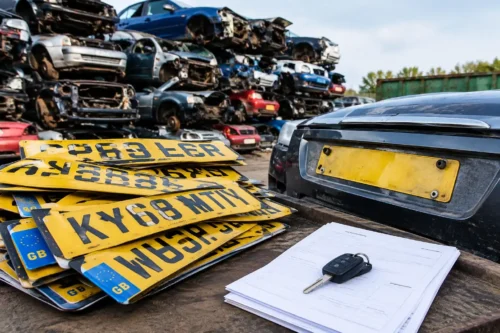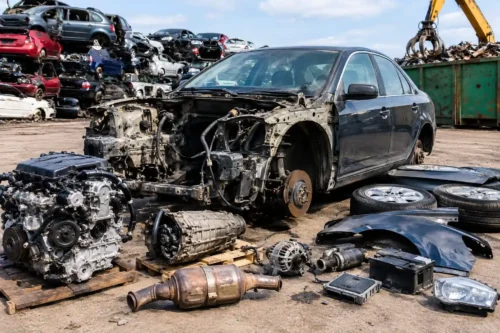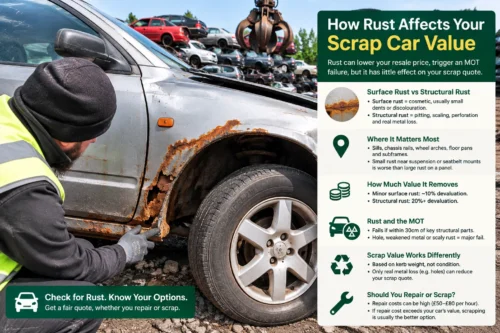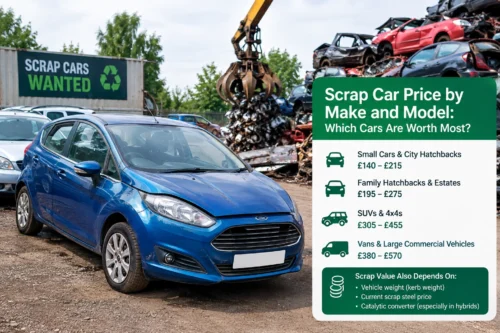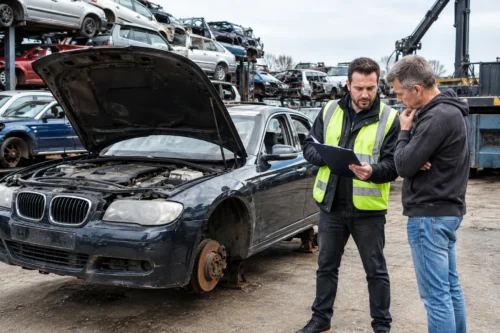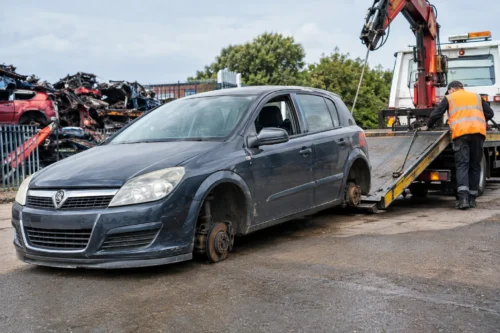
Many vehicle owners hand over their car and still get road tax demands weeks later. Parking fines arrive. Speeding notices follow. A licensed Authorised Treatment Facility (ATF) stops all of that. ATFs legally de-pollute the vehicle and notify the DVLA directly. After ATF processing, you receive a Certificate of Destruction (CoD). The CoD removes you as the registered keeper from the official DVLA record. No future liability attaches to that vehicle. UK environmental law under the ELV Directive requires this process. Skipping a licensed ATF leaves your name linked to the car permanently.
What Is an End of Life Vehicle Under UK Law
Which Vehicles Count as ELVs and Which Are Excluded
Passenger cars and small vans under 3.5 tonnes qualify as ELVs under UK law. A hatchback, saloon, estate car, SUV, or MPV all fall under the M1 vehicle category. Any light commercial vehicle under 3.5t fits the N1 vehicle category. A motorbike exclusion and lorry exclusion apply neither qualifies today. Spare parts and replacement parts made for vehicles on the UK market from 1 July 2003 also carry heavy metals obligations.
Natural ELVs Versus Premature ELVs: Why the Distinction Matters
A natural ELV is usually over 10 years old with age related wear and tear or high mileage. A premature ELV arrives early through road traffic accidents, fire damage, flood damage, or vandalism. Insurance total loss splits into 4 UK categories A, B, S, and N. A Category A write off means crush only. A Category S write off allows the car back on UK roads after structural repair. The salvage routing decision determines whether the vehicle goes to an ATF facility or a repairer.
The Laws That Govern Car Recycling in the UK
End of Life Vehicles Regulations 2003 and What They Require
SI 2003/2635 sets a 95% recovery target and 85% recycling target by average vehicle weight each year. Parts over 200 grams need material marking so ATFs can sort them correctly. The International Dismantling Information System (IDIS) gives ATFs safe de-pollution data for every model. Cadmium, lead, mercury and hexavalent chromium are banned unless an Annex II exemption applies. Under the dismantling transparency obligation, producers must upload this data within 6 months of launch.
The Scrap Metal Dealers Act 2013 and the Ban on Cash Payments
Section 12 of the Scrap Metal Dealers Act 2013 makes cash payment illegal for all scrap transactions. Licensed dealers must pay only by electronic bank transfer or crossed cheque. Every ATF facility must hold a site licence from the local authority. Dealers verify photo ID and proof of address from every seller this creates a full audit trail. Any operator offering cash almost certainly lacks a valid scrap metal dealer licence.
How Post Brexit Regulation Differs from the Original EU Directive
The UK Withdrawal Act 2018 converted the ELV Directive 2000/53/EC into domestic law at Brexit. The UK rejected dynamic alignment so future EU ELV Regulation updates apply automatically in the EU but not here. The UK EU ELV regulatory gap period now exists UK rules sit frozen at 2020 levels. A Defra review expects outcomes in 2026 or 2027, covering motorcycles, heavy duty vehicles, and lithium ion battery regulation. Northern Ireland stays closer to EU standards under the Windsor Framework.
Who Is Allowed to Legally Recycle a Car in the UK
What Makes a Facility an Authorised Treatment Facility
Environmental permit approval requires an impermeable surface across all de-pollution bay and storage areas. An oil separator must handle all drainage to stop fluids reaching water courses. The EA permit application needs site plans, a waste management plan, and financial competence evidence. Until de-polluted, every ELV counts as hazardous waste in England and Wales. A vehicle to facility compatibility check confirms the site can safely handle that specific vehicle’s contents.
How to Verify That a Scrapyard Holds a Valid Environmental Permit
The Environment Agency public register lets you search by site name, permit reference number, or postcode. SEPA, NRW and NIEA each run separate public registers for Scotland, Wales, and Northern Ireland. The on site ATF verification test covers 3 checks visible de-pollution bay, bank transfer payment, and a Certificate of Destruction before you leave. Cash offers are a red flag indicator licensed ATFs never pay cash.
The Consequences of Using an Unlicensed Operator
Unlicensed scrapyards cannot issue a Certificate of Destruction so your vehicle stays on the DVLA register under your name. Every future parking fine, speeding ticket, and road tax demand legally attaches to you. The phantom registration risk has no end date only a new licensed ATF transaction resolves it. An unlicensed operator may also use your car for ringing, attaching its identity to a stolen vehicle. Environmental liability from illegal fluid disposal does not automatically transfer away from the original keeper.
ELV Recycling Process at an Authorised Treatment Facility
Stage One: Vehicle Collection and Condition Assessment
Vehicle collection happens by owner delivery, ATF collection, or recovery vehicle transport. The ATF runs a DVLA record check against the registration number before processing begins. A completeness threshold assessment confirms the engine, gearbox, and catalytic converter are present. Missing components remove the free take back eligibility under the ELV Producer Responsibility Regulations 2005. No V5C document means the owner must notify DVLA separately in writing.
Stage Two: Depollution Removing Hazardous Fluids and Components
Depollution is legally required before any crushing under the ELV Regulations. Each vehicle holds 4 to 6 litres of engine oil, plus brake fluid, coolant, transmission fluid and AC refrigerant gas. The circuit purge stage flushes residual contamination from each system after draining. Seatbelt pre-tensioners carry a small pyrotechnic charge neutralised before shredding. Reverse osmosis, evaporation, electrolysis and crystallisation all purify recovered fluids for safe processing.
Stage Three: Dismantling and Recovery of Reusable Parts
Catalytic converter removal recovers platinum, rhodium, and palladium for specialist smelters. Copper wiring, alloy wheels, alternators and starter motors all follow the parts certification pathway before resale. Thermoplastic polyolefin (TPO) from plastic bumpers recycles back into polymer production. Glass gets ground into sand for construction or tableware use. High oil prices increase demand for recycled plastic and low prices reduce it.
Stage Four: Metal Shredding, Separation and Material Recovery
Hydraulic press compaction reduces the body before the high powered industrial shredder processes it. An electromagnet pulls all ferrous metal from the shredded stream first. An eddy current separator then isolates aluminium and copper from remaining material. The post shredder metals cascade runs magnetic separation, eddy current separation and detinning in sequence. Caustic soda dissolves tin coatings, recovering tin separately from the bath.
Stage Five: Automotive Shredder Residue Disposal
Automotive Shredder Residue (ASR) contains plastic fibres, rubber, foam, glass fragments and textile fibres. Lead and zinc residues classify ASR as hazardous under the Hazardous Waste Regulations 2005. Pyrolysis converts ASR into synthetic crude oil, recovering roughly 40 to 60% as oil equivalent. The ASR recovery ceiling limits how close UK recycling gets to the 95% recovery target. Treatment technology remains unevenly deployed across UK specialist ASR treatment facilities.
The Certificate of Destruction and Your Legal Position
What the Certificate of Destruction Contains and Who Issues It
Certificate of Destruction fields include the vehicle registration mark, VIN, ATF name, ATF address, and date of issue. The VIN to registration distinction matters here the VIN is the permanent chassis identifier. A registration mark can transfer to another vehicle, but the chassis number cannot. The ATF transmits the CoD electronically to DVLA Swansea at point of acceptance. You receive a paper or digital copy as your proof of legal disposal.
What Happens to Your Legal Liability Without a CoD
Keeper liability continues with no end date under the phantom keeper condition. The DVLA keeps sending road tax demands, MOT reminders, and insurance renewal notices to your address. Any parking fine, speeding penalty notice, or congestion charge tied to that vehicle reaches you. Ringing risk also rises a stolen car can take your scrapped vehicle’s identity if no CoD closes the registration. Only a new licensed ATF transaction resolves open ended DVLA registered keeper status.
How the CoD Is Recorded on the DVLA Database
ATF electronic notification reaches DVLA Swansea the moment the facility accepts your vehicle. The dual notification protocol requires two acts ATF electronic transmission and your own V5C Section 9 posted to DVLA. Both must happen for full legal closure. Check the DVLA vehicle enquiry service a few weeks after scrapping to confirm scrapped status appears. The Motor Insurance Database (MID) also updates, stopping continuous insurance enforcement demands on a vehicle you no longer own.
Your Legal Obligations as the Registered Keeper
How to Notify the DVLA When Your Car Is Scrapped
V5C logbook notification goes by post only the DVLA online service does not cover scrapping to an ATF. Fill in Section 4 (post April 2019 V5C) or Section 9 (pre-April 2019) with the ATF name, ATF address, and date of transfer. Post it to DVLA, Swansea, SA99 1BD as soon as the vehicle leaves your possession. Keep a copy of the completed section and your ATF receipt during the notification transit period. The DVLA sends a confirmation letter to your registered address after processing.
What to Do if You Cannot Find Your V5C Logbook
Lost V5C situations follow the lost V5C resolution for two separate paths. Apply for a replacement using the V62 form, available at any Post Office, for a £25 fee. Alternatively, write directly to DVLA, Swansea, SA99 1BD with your vehicle registration number, make, model, date of disposal, and ATF name and address. The ATF can still accept your vehicle and issue a CoD without the V5C. Bring an MOT certificate, insurance document, or purchase receipt as alternative proof.
Penalties for Failing to Inform the DVLA
DVLA enforcement allows fines up to £1,000 for failing to notify after scrapping. The continuous insurance enforcement (CIE) system cross references your registration against the Motor Insurance Database automatically. Cancel your insurance but miss the DVLA notification a fixed penalty notice arrives with no warning. Road tax arrears, parking penalty charges, and speeding notices all stack simultaneously. The accumulated keeper penalty stack compounds across DVLA, local authority and UK Magistrates Court with no cap on duration.
What Happens to the Materials After Your Car Is Recycled
Where the Steel, Aluminium and Copper Go
Flat steel sheet leaves UK ATFs and enters electric arc furnaces at domestic steel mills. Recovered steel rolls into supermarket tin cans, building rebar, railway tracks and new automotive steel body panels. Aluminium ingots go to aerospace, automotive and packaging manufacturers after smelting. Copper billets enter wire drawing plants ending up in electrical motors and generators. The domestic metal supply contribution from UK ELV recycling cuts dependence on primary ore imports significantly.
How Catalytic Converter Metals Are Recovered
Platinum, rhodium and palladium sit on the ceramic substrate inside every catalytic converter in trace quantities. Each platinum group metal (PGM) is worth more per gram than gold on current markets. Specialist smelters use hydrometallurgical processing (acid leaching) or pyrometal liturgical processing (high temperature) to extract them. A PGM concentration assay determines exact metal content before the smelter sets a price. Recovered PGMs supply medical devices, industrial catalysts, jewellery and hydrogen fuel cells.
What Automotive Shredder Residue Is and How It Is Treated
Automotive Shredder Residue (ASR) makes up roughly 20 to 25% of total vehicle weight after clean metals are removed. Lead and zinc residues classify ASR as hazardous under the Hazardous Waste Regulations 2005. General landfill is not a legal disposal route for ASR. Pyrolysis converts shredder fluff into synthetic crude oil, recovering 40 to 60% as usable oil equivalent. The ASR recovery gap between the 95% ELV recovery target and full material recovery remains the biggest technical challenge in UK car recycling today.
Electric Vehicles and the Future of UK ELV Regulation
Why Lithium-Ion Batteries Require Different De-Pollution Procedures
Lithium-ion battery pack voltage reaches 800V fatal contact risk without insulated tooling. Only technicians holding the IMI Level 3 Award in Electric/Hybrid Vehicle System Repair and Replacement carry out battery isolation procedures. Thermal runaway can reignite a battery for 24 to 72 hours after apparent extinguishing sand containment and water immersion protocol both apply. The battery disposition decision uses State of Health (SoH) testing to determine if the pack stays above the 80% capacity threshold for second life energy storage. Packs below that threshold enter hydrometallurgical processing, separating black mass into lithium, cobalt and nickel fractions.
What the UK Regulatory Review Means for Vehicle Owners from 2026
Defra’s UK ELV regulatory review expects outcomes in 2026 or 2027 covering motorcycles, heavy duty vehicles, and battery regulation updates. The regulatory continuity principle applies now current ELV Regulations 2003 remain fully in force during the review. Don’t delay scrapping decisions based on anticipated changes. Extended producer responsibility (EPR) will likely expand to broader vehicle categories after the review concludes. Northern Ireland faces a different path under the Windsor Frame work, staying closer to EU alignment than Great Britain.
FAQs
Can I scrap a car without the V5C logbook?
Yes a licensed ATF accepts your vehicle without a V5C. Write to DVLA, Swansea, SA99 1BD with your registration, disposal date and ATF address. A Certificate of Destruction still gets issued.
Am I entitled to free disposal when scrapping my car?
Yes since 2007, the last registered keeper gets free disposal under the ELV (Producer Responsibility) Regulations 2005. Your engine, gearbox and catalytic converter must all be present.
How long does the car recycling process take at an ATF?
Most ATFs collect the same day or next day. Your Certificate of Destruction issues on acceptance. Chase it after 7 days. DVLA de-registration is confirmed a few weeks later.
Is it legal to sell a scrap car for cash in the UK?
No cash is illegal under Section 12, Scrap Metal Dealers Act 2013. Only bank transfers or crossed cheques are legal. A cash offer means no CoD and indefinite keeper liability.
How do I check whether a scrapyard is a licensed ATF?
Search the Environment Agency register for England, SEPA for Scotland, NRW for Wales, NIEA for Northern Ireland. Check VRAC certification through the Vehicle Recyclers Association.
Book Now your quote Car Recycling now
Scrap My Car Services is a licensed Authorised Treatment Facility serving the United Kingdom. Every vehicle receives a Certificate of Destruction on collection. Payment goes by bank transfer only, never cash. Check your free disposal entitlement today and get an instant quote.