MOT failure means 1 of 3 defect verdicts. Dangerous defects stop the car from driving legally. Repair costs versus scrap value decide the smarter financial move. DVLA controls the legal scrapping process from start to finish.
What an MOT failure actually means for your vehicle
The three MOT outcome categories: pass, advisory and fail
An MOT pass confirms your vehicle meets all required safety and environmental standards on that test date. An MOT advisory notice flags items that are deteriorating but have not yet reached failure level. Multiple advisories alongside a failure change the decision calculus entirely and repair costs stack fast. The MOT fail means the vehicle cannot be legally driven on a public road.
Dangerous defect vs major defect and what each allows
A major defect means the vehicle cannot be used on the road until repaired. The DVSA allows driving directly to a pre-booked repair appointment only. A dangerous defect carries a stricter rule that the vehicle cannot move at all, even to a garage. Driving on a known dangerous defect invalidates your insurance, according to gov uk guide lines. Free collection by a licensed ATF facility becomes the only legally compliant exit route.
MOT failure categories and what each costs to repair
Structural corrosion repairs
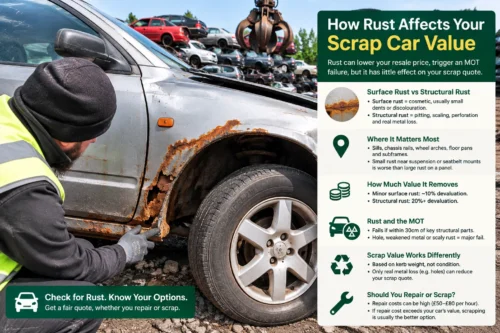
Structural corrosion on load bearing chassis components, sills, or subframe mounting points costs between £800 and £2,000 for welding. A successful weld rarely eliminates rust permanently. Adjacent panels often fail within 12 months after repair.
Emissions and catalytic converter failures
An emissions failure does not always mean catalytic converter replacement. A faulty lambda sensor costs only £80 to £200 to fix. DPF blockage on diesel vehicles often clears with a regeneration service at £100 to £200 before full replacement is needed.
Brake and suspension component failures
A worn brake disc carries a major defect classification. A loose brake disc becomes a dangerous defect the vehicle cannot move at all. Vehicles over 100,000 miles rarely fail on one component alone. Suspension bushes, caliper sliders and brake pads often fail together, pushing combined costs past the scrap threshold.
Minor defects that rarely justify scrapping
Minor MOT defects, faulty bulbs, worn wiper blades, and small tyre tread concerns above the 1.6mm legal minimum cost between £50 and £200 to fix. A minor defect on an otherwise sound vehicle signals it is worth repairing, not scrapping.
When scrapping makes more financial sense than repairing
The 50 percent rule and how to apply it
The 50 percent rule states that repair costs exceeding half the vehicle’s realistic post repair market value make scrapping the better financial choice. Online valuation tools like Auto Trader and We Buy Any Car apply a condition premium that does not apply to a vehicle with an MOT failure. Reduce any online estimate by 30 to 50% before comparing it against repair costs. Include advisory items likely to fail at the next MOT inside your total repair figure, not just the current failure items.
Vehicle age and mileage as multipliers on the repair decision
Vehicles over 12 years old with more than 120,000 miles sit at a £500 to £1,500 value floor regardless of make or model. According to RAC breakdown statistics, vehicles over 12 years old break down at 3.5 times the rate of cars under 5 years old. A £1,400 repair today recovers value that drops to £1,100 to £1,300 within 12 months on an ageing vehicle. Worn engines also add £200 to £400 in extra annual fuel costs on top of repair bills.
What a failed MOT car is worth in the UK
How scrap value is calculated by weight and metal price
Scrap value is calculated by multiplying vehicle weight in kilograms by the current ferrous metal price per tonne. A failed MOT status has zero effect on scrap pricing. ATF facilities apply a margin below the full LME ferrous metal spot price, so your payout never equals the raw market rate. Catalytic converters contain platinum group metals valued separately from body steel, removing one before scrapping often reduces the ATF offer more than a private sale recovers.
Scrap payout ranges by vehicle class
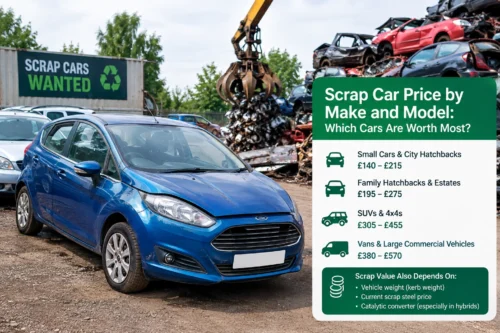
A small hatch back weighing around 900kg returns between £180 and £250 at current 2024/2025 metal prices. A family saloon at approximately 1,200kg typically pays £150 to £300. Large saloons, 4x4s and SUVs at 1,400kg reach £280 to £500 in complete condition. Vans between 1,500kg and 2,500kg achieve £250 to £500 depending on type. Payment arrives on collection day or within 24 to 48 hours by bank transfer.
Cascading failures and the true 12 month cost of keeping a failing vehicle
Why structural corrosion repairs rarely stop at the first quote
Structural welding fixes the specific fail point the MOT tester identified. Rust does not stop there. Moisture continues attacking adjacent panel steel within 12 to 24 months. A failed sill commonly accompanies corroded brake lines, floor pan deterioration and rear subframe corrosion on the same vehicle. The total 24 month repair path on a corrosion affected vehicle typically reaches £1,800 to £2,500 once subsequent advisory conversions are included.
Hidden running costs of a vehicle in decline
Worn engines consume £200 to £400 more in fuel annually than newer equivalents. Third party insurance premiums on aging vehicles stay static or rise despite the car’s falling market value. Breakdown recovery fees, road side repair charges and lost time rarely appear in the initial repair vs scrap calculation. MOT advisory items left unresolved between tests convert into hard failures at the next inspection costs the owner already had notice of but never cost into the decision.
The legal process of scrapping a failed MOT car in the UK
What an Authorised Treatment Facility does and why it matters
An Authorised Treatment Facility (ATF) issues the Certificate of Destruction. No garage or scrap dealer can do this. The End of Life Vehicles Regulations 2003 made ATFs mandatory. Every scrapped UK car must go through one. The Environment Agency licences ATFs in England. Scotland, Wales, and Northern Ireland have separate licensing bodies. Depollution happens before any dismantling starts. It removes fuel, oil, brake fluid, coolant, airbag propellant and refrigerant.
DVLA notification, V5C Section 9 and the Certificate of Destruction
The Certificate of Destruction ends the registered keeper’s legal responsibility for the vehicle. The ATF notifies DVLA automatically on CoD issuance no separate contact is needed. V5C Section 9 applies only when selling to a scrap dealer rather than booking direct ATF collection. A vehicle without a V5C logbook can still be scrapped. Retain the CoD reference number to confirm your legal responsibility has ended on DVLA records.
When to cancel your insurance after scrapping
Keep insurance active until the Certificate of Destruction is received, not just until collection day. A gap exists between ATF collection and formal CoD issuance, sometimes several days. During that window, the registered keeper retains liability for any incident involving the vehicle. Declare a SORN if the vehicle sits on a public road before collection. Cancelling mid term usually returns a partial insurance refund without affecting your no claims bonus.
Selling a car with a failed MOT privately versus scrapping it
Legal disclosure obligations for private sellers
Selling a car privately with a failed MOT is legal in the UK. The seller must disclose the failure honestly and hand over the MOT failure certificate. Concealing a known defect creates misrepresentation liability under common law a sold as seen disclaimer does not remove that risk. A vehicle carrying a dangerous defect cannot be driven on a public road by the buyer, and the seller must communicate this clearly before sale.
What private buyers realistically offer on a failed MOT vehicle
Private buyers price in the worst case repair scenario, not the actual garage quote. A vehicle with a known £400 structural corrosion failure typically attracts offers £600 to £700 below its MOT passing private sale value. Popular models like the Ford Focus, Vauxhall Astra, and VW Golf perform better on eBay Motors and Facebook Marketplace due to strong parts demand. Low demand or rare models rarely outperform a straightforward ATF scrap quote on a failed MOT vehicle.
FAQs
Can I scrap a car without a valid MOT in the UK?
MOT status has no bearing on scrapping. A licensed ATF collects the vehicle from any location. Only the V5C logbook, photo ID and registration number are needed. No driving required.
Does MOT failure reduce the scrap value of my car?
MOT failure does not reduce scrap value. A licensed ATF calculates the offer from vehicle weight and current ferrous metal prices only. A failed MOT car returns the same price per kilogram as a passing one.
How long does free scrap collection take after I request a quote?
Most licensed ATFs arrange free collection within one working day. Provide your registration number, location and basic condition details. Payment arrives on collection day or within 24 to 48 hours.
Can I scrap a non runner or undriveable car?
Non runners and undriveable vehicles are fully eligible for scrapping. A licensed ATF collects them as standard at no charge. No towing or independent transport arrangements are needed from the owner.
Do I need to notify the DVLA myself when I scrap my car?
No. The ATF issues a Certificate of Destruction automatically, which updates DVLA records directly. Retain the CoD reference number and cancel insurance only after receiving confirmation.
Vehicle has Failed its MOT Contact Now
Scrap My Car Services collects failed MOT vehicles across the United Kingdom same day, at no charge. Get a free scrap quote today and receive your Certificate of Destruction without any paperwork risk.